The next time your family challenges your values, don't be left without words.
A practical Kant-based field manual with 12 calm, reasoned responses to the moral challenges your children and grandchildren throw at your values — no philosophy degree required.
- 12 ready-to-use responses to common family challenges
- Each answer includes a short reply, full reasoning, pushback handling, and a rehearsal line
- Built on Kant's moral philosophy, translated into plain English
- Designed for calm conversations — not shouting matches
Instant digital access. No philosophy background needed.
You know they're wrong. But in the moment, the words don't come.
“That's just your opinion.”
“Who are you to judge?”
“You only believe that because you were raised that way.”
You feel the truth in your bones. You reach for "because the Bible says so" — and the other person's eyes go flat. The conversation ends. Everyone moves on to dessert. And five minutes later, you know exactly what you should have said.
The problem isn't that your convictions are weak. The problem is that you have been defending them on ground the other person already rejects.
Every time you freeze, your values become easier to dismiss.
Family conversations repeat. The same objections come back — at Thanksgiving, at Sunday lunch, in the kitchen when it's just the two of you. Silence teaches them that your convictions are only feelings. Anger confirms their stereotype. Avoidance leaves the next generation with no serious moral answer at all.
The next conversation may not announce itself. It may come between dessert and coffee, while everyone else is half-listening. And when it does, you will either reach for the same old answer — or you will be ready.
You don't have to prove God first.
When someone rejects Scripture, starting with Scripture closes the conversation before it opens. The better first move is to begin with reason, fairness, dignity, and moral consistency — things they already use, even when they deny your faith.
Your grandson may reject your Bible verse. But he still believes cruelty is wrong, justice matters, people have dignity, and hypocrisy is real. That is where the conversation begins.
The Common Ground Method
Never start on ground they reject. Start on ground they already stand on.

- IIdentify the hidden moral assumption behind their challenge.
Every objection smuggles in a value. Find it.
- IIShow that they already rely on a standard beyond personal opinion.
Their own words assume a moral law they claim doesn't exist.
- IIILead them from their own reason toward the moral law they thought they had rejected.
You don't impose. You reveal.
Bible → Church → Tradition → Authority
Reason → Fairness → Dignity → Moral Law
You do not win by imposing your framework. You win by showing them that their framework already contains what they claim to reject.
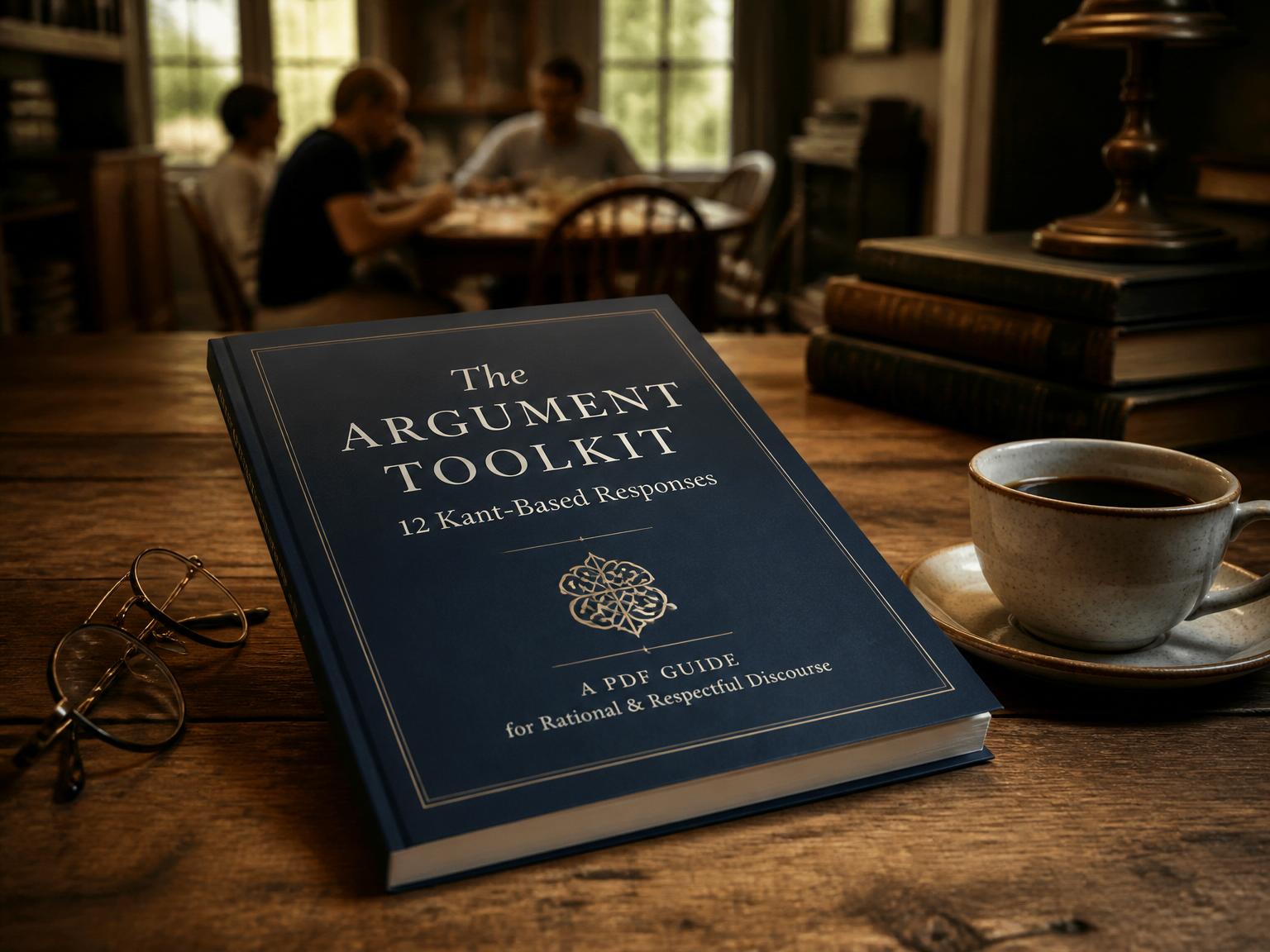
The Argument Toolkit
12 Kant-based responses to the challenges your family will throw at your values.
A practical PDF field manual for older Christian believers who want to answer moral objections with clarity, calm, and dignity. It turns Kant's moral philosophy into plain-English responses you can actually use — at your own family table.
Clear answers for the sentences you've heard a hundred times.
“Morality is just opinion.”
You'll expose the contradiction calmly — without raising your voice.
“Who are you to judge?”
You'll distinguish judging an action from condemning a person.
“You only believe that because you were raised that way.”
You'll answer the origin-vs-truth mistake in one sentence.
“I don't need God to be a good person.”
You'll concede the right point — then ask the deeper question.
“Science has proven there's no God.”
You'll explain the limits of science without sounding anti-science.
When they push back…
You'll have a second answer ready, before the conversation shifts.
The 12 challenges — each answered in six parts.
- 01"Morality is just opinion. It's relative."
- 02"Who are you to judge?"
- 03"You only believe that because you were raised to."
- 04"I don't need God to be a good person."
- 05"A little white lie never hurt anyone."
- 06"Do whatever you want, as long as you don't hurt anyone."
- 07"Science has proven there's no God, no soul, no free will."
- 08"Religion is just a crutch for people who can't handle reality."
- 09"Values change over time. There's no fixed truth."
- 10"People are just animals. It's all chemistry and instinct."
- 11"You're just imposing your morality on other people."
- 12"If God is good, why is there so much suffering?"
Every argument is built the same way.
What they actually say — in their words.
A calm reply you can speak in one breath.
The reasoning, in plain English.
Why it holds up — without the jargon.
Your second move, ready in advance.
A line to practice before you need it.
One argument, opened up.
"If it's just opinion, then you can't tell me I'm wrong about anything — including this. The moment you say I'm wrong, you've admitted there's a standard above both our opinions."
It reveals the contradiction inside moral relativism. The person says morality is only opinion, but still speaks as if some things are truly wrong. The argument starts from their own moral language — not from religious authority — so it cannot be dismissed as "just your faith."
Built for real conversations, not internet debates.
- ✦Based on Kant's moral philosophy, translated into plain English.
- ✦Every argument includes both the quick answer and the deeper reasoning.
- ✦Pushback sections prepare you for the second exchange — where most people lose their footing.
- ✦Honest about Kant where his views are contested. No hand-waving.
- ✦Designed to preserve dignity, not humiliate family members.
Built for people who don't think of themselves as philosophers.
Try it for 7 days. Read one argument. Practice one line.
If you don't feel clearer, calmer, and better prepared for the next difficult conversation, request a refund within 7 days. No forms. No explanations.
Get the complete Argument Toolkit today.
What's included
- The complete PDF guide
- 12 Kant-based responses
- Short answers for real-time conversations
- Full explanations in plain English
- Kantian principles translated for non-philosophers
- 'When They Push Back' responses for every argument
- Rehearsal lines you can practice before the moment comes
- Plain-English glossary of key Kantian terms
Included bonuses
- One-Page Dinner Table Cheat Sheet
Fold it into your Bible or leave it in a kitchen drawer.
- The Common Ground Method Quick Guide
The three-step method on a single page.
- 7-Day Rehearsal Plan
One argument a day. Ready by next Sunday.
Instant digital access. Read it today. Use it the next time the conversation comes around.
Anything else worth knowing.
The next conversation will come. Be ready for it.
You do not need to memorize a philosophy textbook. You do not need to shout. You do not need to win the whole argument in one lunch. You only need one clear answer, spoken calmly, that makes dismissal impossible.
Defend your values without betraying them.